The Rules of the Road
Understanding and Applying the COLREGs
Second Edition · June 2026
A second edition of the COLREGs study guide first issued in May 2026. The first edition set out the Rules and worked them. This edition rebuilds the foundation in front of them, so that an officer learns what the Rules say, and why they are built and worded as they are.
How to Read This Guide
What this guide is for
This is not a guide for passing a Rules of the Road examination, though it will help with one. It is a guide for understanding the Rules: where they came from, how the instrument is constructed (throughout this guide, “the instrument” means the COLREGs itself, the International Regulations for Preventing Collisions at Sea, 1972, treated as a single formal legal document, which is what the word means in law), why it is written in the legal language it uses, what its words mean, and what it expects of the officer in the gaps it deliberately leaves. The aim is that you come away able to reason about a situation the Rules do not spell out, rather than able only to recite the ones they do. An officer who has memorised the text still fails at the points where the text hands the decision back to him; this guide is about those points.
Who it is for
It is written for the officer meeting the Rules properly for the first time as an Officer of the Watch, and the reader is addressed as the OOW throughout. It assumes you can handle a ship and know the sea; it does not assume you have ever taken the Rules apart.
How it is built
The guide is in three parts, with reference material at the back.
Part I, Foundations builds the understanding everything else stands on: the single idea behind the Rules, where they came from, who they bind and why a warship of the Royal Australian Navy holds itself to them, how the instrument is laid out, why it is legalistic and how to read it, what its words mean, how encounters develop, why the apparent contradictions exist, and what good seamanship actually demands. These ten chapters are meant to be read in order, but each can stand on its own.
Part II, Rule by Rule analyses every Rule in numerical order, and because no Rule operates alone, each analysis maps how it interacts with the Rules it modifies, defers to, or is overridden by.
Part III, Worked Scenarios puts the method to work on real encounters, civilian and naval.
Back matter holds the reference apparatus: an A-to-Z glossary, the full text of the Rules annotated to show the significance of their wording, and a short reading list.
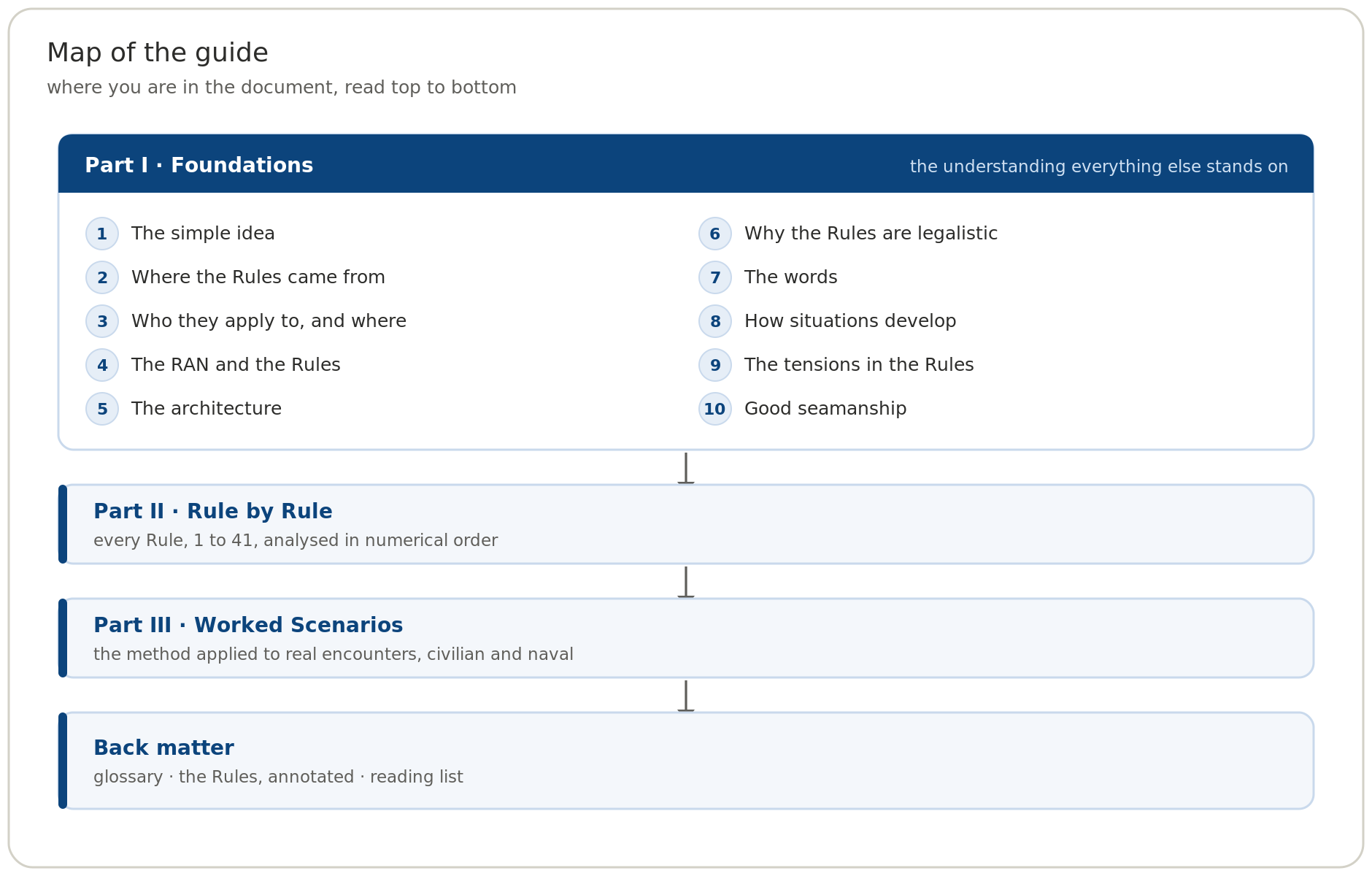
Figure 0-1. Map of the guide. The three parts and the back matter, and how they build on one another.
If you are short of time
Read in order if you can. But if what you are after is the close reading of the language, the difference a single qualifying phrase makes, why “so far as practicable” is not “so far as possible,” and what words like “notwithstanding” and “deemed” actually do, go straight to Chapter 6 (Why the Rules Are Legalistic) and Chapter 7 (The Words). They are the longest and most detailed chapters in the guide, and they are designed to be read on their own.
The devices used in the text
A handful of recurring callouts and conventions run through the guide:
- TRANSLATION boxes set a Rule’s legal wording beside a plain reading, and note what the legal version achieves that the plain one cannot. They are introduced in Chapter 6 and run through Part II.
- PRACTICAL NOTE marks a point about what a Rule means for you in practice on the bridge.
- DRAFTING ISSUE marks a place where the wording itself is awkward, ambiguous, or easily misread.
- Figures are numbered (Figure 5-1, and so on) and carry diagrams and reference panels.
- In Part II, each Rule is marked FULL (complete analysis, for the Rules that carry judgement and case law) or CONCISE (brief treatment, for the definitional and structural Rules).
- IN BRIEF boxes open each chapter of Part I with its content in a few sentences, for preview and for revision.
- Court cases are cited in italics (Sea Star–Horta Barbosa, and so on). Sources are cited inline in brackets.
Conventions and sources
The reader is the OOW. The text of the Rules used throughout is MISCPUB 0127 (the edition incorporating the December 2013 amendments), and rule references are to it. The standard commentary referred to is Cockcroft & Lameijer, A Guide to the Collision Avoidance Rules, 7th edition. Naval and ship-handling references are to BR45 (the Admiralty Manual of Navigation); the supplementary naval material draws on CUES and ATP-1, and the law-of-the-sea points on UNCLOS 1982. Spelling and usage are Australian.
Table of Contents
Part I, Foundations
- The Simple Idea
- Where the Rules Came From
- Who the Rules Apply To, and Where
- The RAN and the Rules
- The Architecture
- Why the Rules Are Legalistic, and How to Read Them
- The Words
- How Situations Develop
- The Tensions in the Rules, and Why They’re There
- Good Seamanship and the Ordinary Practice of Seamen
Part II, Rule by Rule
- Part A, General (Rules 1 to 3)
- Part B, Steering and Sailing Rules (Rules 4 to 19)
- Parts C and D, Lights, Shapes, Sound and Light Signals (Rules 20 to 37)
- Parts E and F, Exemptions and Verification (Rules 38 to 41)
Part III, Worked Scenarios
- Worked Scenarios
Back matter
- Appendix A: A-to-Z Glossary
- Appendix B: The Rules, Annotated (with the Annexes)
- Appendix C: Reading List